A puppet is a country that is de jure independent but is more or less controlled by another, often stronger nation, through an installed government that is loyal to the controlling nation.
When a country is puppeted, its government is replaced by one installed by the puppet master, matching the puppet master’s ideology. If a puppet master declares war, they can call in their puppets as allies. In the peace conference that ensues after a successful war, puppeted countries will not be able to make demands by themselves, though the puppet master can dictate demands in favor of its puppets if they choose to do so. As a result, an already puppeted country cannot puppet other countries.
If a puppet master is forced to capitulate, its puppets will automatically capitulate as well if it isn’t in a faction with a major country that has yet to capitulate. If a puppet master capitulates but there are still majors in a puppets faction, the puppet will earn autonomy points if TFV/DOD/WTT is enabled. Upon defeating a puppet master (and other majors in faction with it), the victorious nations can choose to detach puppeted countries from their puppet master, making them free-standing nations again. Communist countries get a 70% cost reduction for puppeting other countries.
Puppet Master
The puppet master nation may import goods from its puppet or subject state at a rate discounted below the standard trade rate of up to 8 loads of a resource per factory. If the Together for Victory DLC is active, a puppet or an integrated puppet (such as Malaya) provides 80 loads per factory to its British master (90% discount), while British Raj colony offers 16 loads (50% discount) and British dominions offer 10 loads per factory (25% discount). Without the DLC, the Raj is a puppet and the only discount is for puppets.
The puppet master may access far more of the puppet’s resources than it could otherwise with its own trade laws if directly annexed. Extra Trade for overlord provides a bonus on top of the puppet’s Trade Law to market rate. So if a Puppet would have 200 Steel available and have Export Focus, typically only 50% of their resources go to Export (100 steel) the rest can be kept for themselves. With the Extra trade bonus of +25% (from Dominion level autonomy) this brings the total steel available to export from a puppet to 125 out of their total of 200 for an effective to market rate of 62.5% (50% * 125%). This can mean with Integrated Puppets the puppet master may purchase all of their resources even if they switch to ‘Closed Economy’.
At certain levels of autonomy a puppet master may request license production of a puppet’s equipment, at a discount or even completely free. In addition to being given access to equipment without needing to research it, there is also a bonus conferred to researching that equipment while the license is in effect. Speeding up research for domestic equipment.
It is possible to “request” control over the troops of the puppet; this provides additional divisions for the puppet master, although puppet divisions may not be very well designed.
When doing so, it is desirable for the player to lend-lease appropriate equipment to the puppet nation which will allow for faster division training as well as combat any existing puppet equipment shortages. Alternatively, the master may request lend-lease equipment from the puppet to drain its equipment stocks.
The master can effectively boost their own manpower by raising units including a mix of master and puppet manpower (70% for a Colony, 90% for a Puppet, and 100% for an Integrated Puppet). Such colonial divisions are controlled by the puppet master. The templates for such colonial divisions are those taken or adapted from the puppet’s own template list (open by clicking the Crown icon at the top of the Division Designer in the Recruit/Deploy menu). If a puppet is newly released, it will receive templates of the puppet master.
Puppeting countries can often be safer than annexing them as it generates less World Tension than territorial annexation, reducing the risk of foreign intervention by other potentially hostile countries.
Disadvantages of having a puppet
If Together of Victory is not active, a puppet retains full control of the territory you grant it, meaning that the master cannot build anything in a puppet’s territory. It is then also not possible to annex a puppet, meaning that creating a puppet causes the mother nation to lose the ability to utilize the puppet’s territory for construction. ,
Puppeting small countries with few resources is less efficient than simply annexing the country, especially if the puppet has less than 8 units of the resource, as factories still have to be paid.
If you give too much land to a puppet, it may refuse to give you your land back.
Being a puppet
Advantages of being a puppet
- Puppets can receive lend lease from their master, even in peacetime. This may help in multiplayer games to grant a puppet a head-start in multiplayer games with a 1936 start date.
- If a nation declares war on a puppet, its master will automatically turn hostile towards the nation that declared war on it, bringing them as well as all their other puppets into the fight.
Disadvantages of being a puppet
- A puppet receives a reduced number of factories for giving resources to its master. This can hinder early-game industry development.
- A puppet can neither justify war goals nor can it declare war on another country, in addition to that, puppets cannot make demands in a peace conference, meaning that a puppet’s territorial expansion is entirely decided by the puppet master.
- If a puppet master declares war on a nation, they can freely force the puppet into the war. If matched up against a stronger opponent and fighting alone, the odds are clearly not in its favor. Even if the puppet proves stronger and defeats that enemy, it gets nothing but glory (and autonomy points) from the war unless the puppet master provides something in the peace or thereafter.
- A puppet has to deal with autonomy or risk further disadvantages in favor of its overlord. One of the quickest and most reliable ways to raise autonomy is to use a continous focus, wasting time that could be used for completeing other national focuses. However, puppets with unique focus trees usually have a national focus that is even quicker than said method
Autonomy system
Autonomy levels
One puppet may act more or less independent than another. To represent the difference between largely autonomous dominions like Canada or Australia, somewhat autonomous colonies like the British Raj, and totally subservient puppet states like Malaya, the game divides subject states into four levels of autonomy. Within each level,
Autonomy has a numerical level between 0 and 1000. At 1000 autonomy, the subject may advance to a higher tier, or become free if it is already a Dominion. At 0 autonomy, the master may decrease autonomy to a lower tier, or annex the puppet entirely if it is already an Integrated Puppet. Changing tiers costs 50 Political Power, while annexing a subject or becoming free costs 300 Political Power.
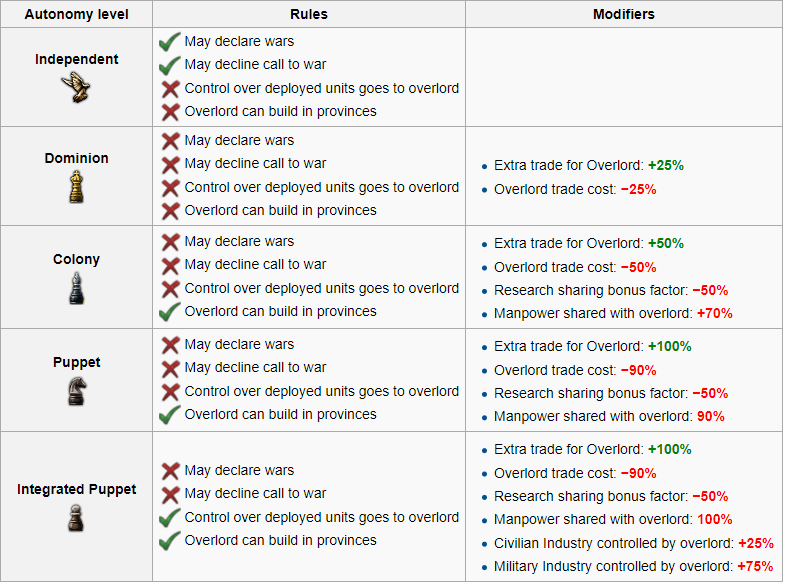
Autonomy levels (fascism)
Subjects of a fascist country have a different system, with some similarities. While there are fewer levels of autonomy (3), more autonomy has to be increased overall to break free (or decreased to annex), as autonomy is now numerically classified from 0 to 1600 at each level. Changing levels is the same as in other puppets, with a 50 political power requirement to change, and 300 political power to gain freedom or annex the subject.
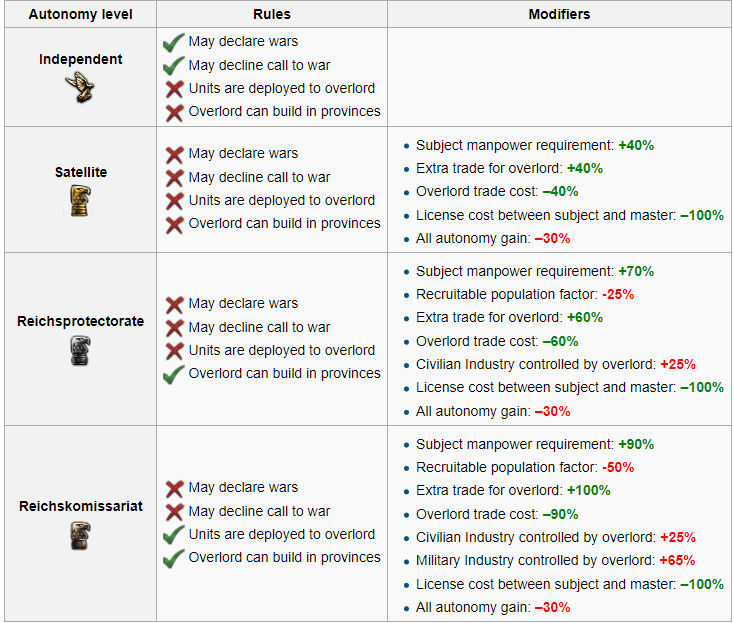
Autonomy levels (Imperial Japan)
Subjects of Japan (and Manchukuo if it becomes independent) have yet another system. There are only 2 basic autonomy levels, with an alternative level unique to Manchukuo (Imperial Subject). Moving from Imperial Protectorate to Imperial Associate requires 2400 autonomy and 50 political power, whereas moving from Imperial Associate to freedom requires 1600 autonomy and 300 political power. The Imperial Subject level caps at 1000 autonomy, and disallows freedom until the national focus “Independence War” is completed.
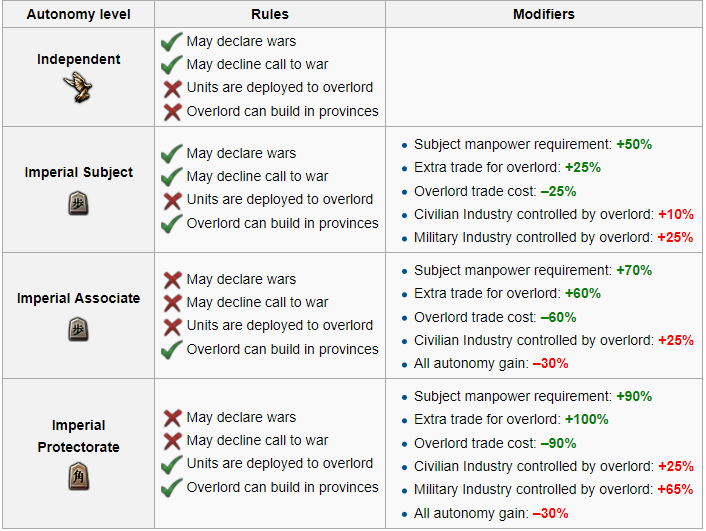
 heartsofiron.home.blog